

Some puzzles are hard because they need knowledge you might not have. These five aren’t like that. Every one can be solved with primary school arithmetic and a bit of care — and almost everybody gets at least one of them wrong anyway.
That’s what makes them worth your time. They don’t catch you out because you’re not clever enough. They catch you out because your brain has a fast, confident answer ready before you’ve finished reading, and that answer feels so obviously right that you never think to check it.
Try all five before you scroll to the answers. Be honest with yourself about your first instinct — that’s the interesting part.
1. The Bat and the Ball
A bat and a ball cost $1.10 together.
The bat costs $1.00 more than the ball.
How much does the ball cost?
2. The Lily Pads
A patch of lily pads sits on a lake. Every day, the patch doubles in size.
If it takes 48 days for the patch to cover the entire lake, how long does it take to cover half the lake?
3. The Widget Machines
If 5 machines take 5 minutes to make 5 widgets, how long would 100 machines take to make 100 widgets?
4. The Two Guards
You’re standing in front of two doors. One leads out. The other doesn’t.
There’s a guard at each door. One guard always tells the truth. The other always lies. You don’t know which is which.
You may ask one question, to one guard.
What do you ask?
5. The Three Doors
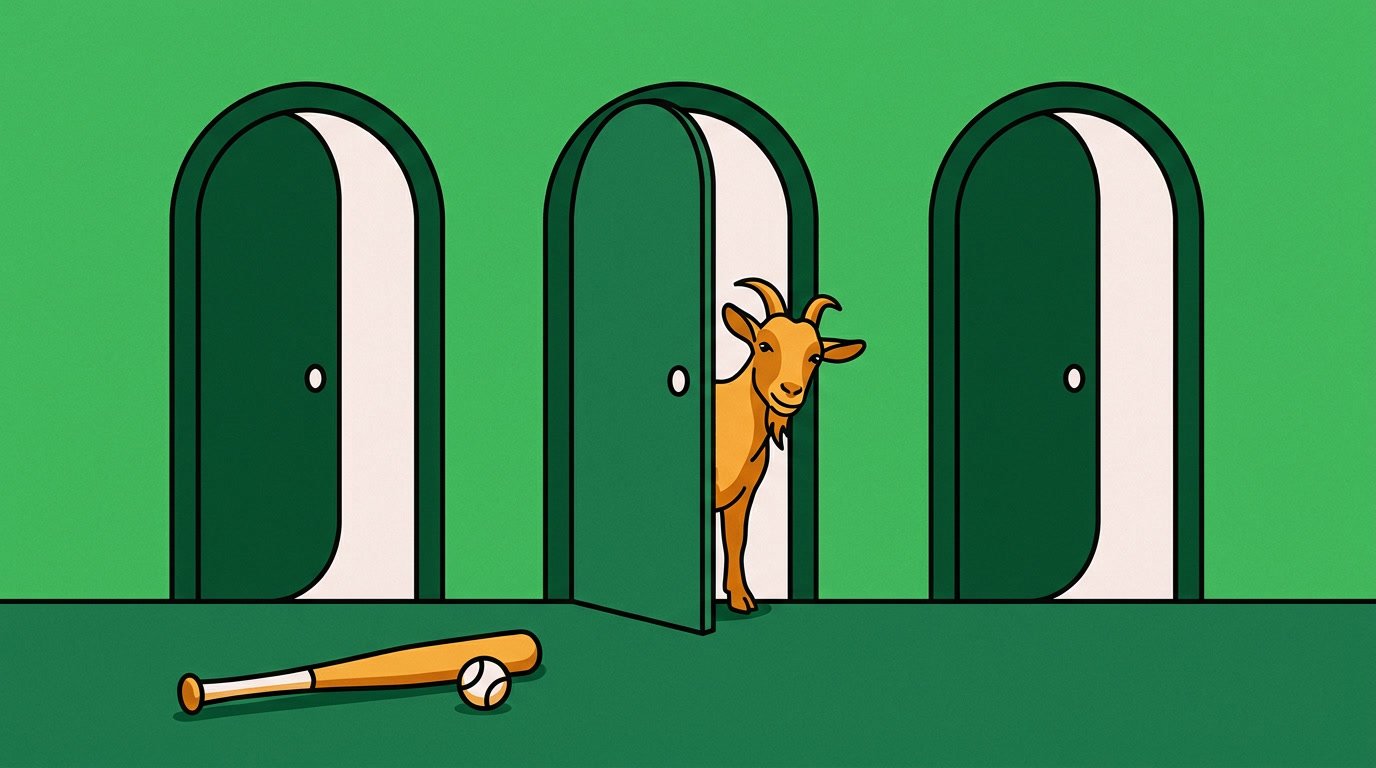
You’re on a game show. Three doors. Behind one is a car; behind the other two, goats.
You pick Door 1.
The host — who knows what’s behind every door — opens Door 3, revealing a goat. Then he offers you a choice: stick with Door 1, or switch to Door 2.
Does switching improve your chances?
The Answers
Last chance to commit to yours.
1. The ball costs 5 cents
Not 10 cents.
If the ball were 10 cents, the bat would be $1.10 — a full $1 more, yes — but then the pair would come to $1.20, not $1.10.
Work it properly. If the ball is x, the bat is x + $1.00. Together:
x + (x + 1.00) = 1.10
2x = 0.10
x = 0.05
The ball is 5 cents and the bat is $1.05. Difference: exactly $1.00. Total: exactly $1.10.
Why it fools you: the numbers $1.10 and $1.00 sit right next to each other, and 10 cents is the leftover. Your brain performs a subtraction it was never asked to perform, hands you the result, and stamps it obvious. The correct answer needs one extra step — and the wrong one feels finished, so you never take it.
2. Forty-seven days
If the patch doubles every day, then on the last day it goes from half the lake to all of it. So the day before it covered everything, it covered exactly half.
Why it fools you: “half the lake” sounds like it should map to “half the time” — 24 days. But doubling isn’t a straight line. For the first 40 days that patch is a barely visible smudge; nearly all the growth happens right at the end. It’s the same reason a virus, a savings account, or a rumour seems to do nothing for ages and then everything at once.
3. Five minutes
Not 100 minutes.
Read it again: 5 machines make 5 widgets in 5 minutes. So each machine makes one widget in five minutes. That’s the machine’s rate, and adding machines doesn’t change it.
Give 100 machines five minutes and you get 100 widgets. Give them ten minutes and you’d get 200.
Why it fools you: the puzzle is built out of matching numbers — 5, 5, 5 then 100, 100 — which invites you to scale everything at once. But time isn’t the thing that scaled. The machines were always working in parallel.
4. Ask either guard: “If I asked the other guard which door leads out, which would he point to?” Then take the opposite door.
The trick is to build a question that passes through both guards, so the lie gets applied exactly once no matter who you ask.
- Ask the truthful guard. He honestly reports what the liar would say — and the liar would point at the wrong door. So you hear the wrong door.
- Ask the lying guard. He knows the truthful guard would point at the correct door, so he lies and names the wrong one. You hear the wrong door again.
Either way, you’re told the wrong door. Take the other one.
Why it fools you: most people hunt for a question that identifies which guard is which. That’s the wrong target, and one question can’t get you there. The move is to stop caring who’s who and design a question whose answer is reliable regardless.
5. Yes — switch. It doubles your chances.
Sticking wins 1 time in 3. Switching wins 2 times in 3.
Here’s the clearest way to see it. When you first pick Door 1, you have a 1 in 3 chance of being right. Which means there’s a 2 in 3 chance the car is behind one of the other two doors.
The host then opens one of those two — and crucially, he never opens the car. He knows where it is. So that 2-in-3 chance doesn’t evaporate; it collapses onto the single unopened door.
Still not convinced? Scale it up. Imagine 100 doors. You pick one — a 1 in 100 shot. The host then opens 98 doors, all goats, leaving your door and one other.
Would you still fancy your original guess?
Why it fools you: two doors remain, so it feels like a coin flip. But the host’s choice wasn’t random — he had information and he used it. That’s what tilts the odds, and it’s invisible unless you’re looking for it.
The pattern underneath
Four of these five have the same shape. An answer arrives before you’ve finished reading, it feels certain, and checking it would only take a few seconds — but feeling certain is exactly what stops you checking.
That’s not a flaw you can train away, and it isn’t about intelligence. The best you can do is learn to notice the feeling. When an answer arrives instantly and comfortably, that’s precisely the moment to slow down and do the arithmetic.
Which one caught you out? The bat and ball gets nearly everyone the first time.